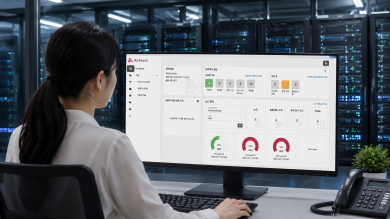
From Infrastructure to Token Factory: AI Data Center White Paper

From Infrastructure to Token Factory: AI Data Center White Paper

2026.08.19

INFINITIXixCSP / AI-Stack

White Paper / 2026

From Infrastructure to
Token Factory

Key gaps and solutions for operators building their own AI data centers

5%

Average enterprise GPU utilization, measured across roughly 23,000 Kubernetes clusters.

Cast AI, 2026

86%

of enterprises running their own GPU infrastructure report utilization below 50%.

VentureBeat Research, 2026

6–12 months

of lost revenue caused by a missing operations layer.

Supercomputing Frontiers, 2026

Chapter 1

The unit of output changed. The budget structure has not.

A data center used to be valued by rack count and PUE; AI workloads replaced the unit of output with the token. Self-build operators are mature at the facility and hardware layer, yet the layer that turns compute into a billable service usually never enters the budget.

“Revenue = tokens per watt × available power capacity” When output is counted in tokens and capacity is constrained by power, how many tokens each unit of power yields is the revenue ceiling.

The gap between cost and revenue

Cost
Hardware depreciation starts on the acceptance date
Revenue
6–12 month gap
Billable output
Acceptance dateOperations layer ready

Chapter 2

Four key gaps, all in the software layer

Low compute utilization

Heterogeneous resources go unmanaged, the lack of virtualization lets a single job monopolize an entire accelerator, and teams hoard reserved capacity.

Insufficient multi-tenancy and governance

No tenant isolation across compute, storage and network, and no resource quotas, access control, audit trails or compliance reporting.

No usage metering or billing

Token metering is an order of magnitude harder than GPU-hours: separate input and output pricing, per-model rates, quotas and overage, reconciliation and audit.

Customer onboarding and time to launch

Without standard APIs and a gateway, a subscribable service catalog and a customer self-service portal, hardware depreciates first and revenue arrives later.

Chapter 3

A three-layer reference architecture, and how the products divide the work

The three layers must not only be in place, they must connect: accurate billing has to identify which tenant, which model and which physical device produced every token.

3

AI cloud operations layer

Multi-tenancy · Metering · Billing reconciliation · Service catalog · Self-service portal

ixCSP
2

AI platform layer

Model deployment · Inference serving · Version control · Model catalog

ixCSP
1

Compute infrastructure layer

Heterogeneous resource management · Virtualization · Scheduling · Monitoring and operations

AI-Stack

With only the infrastructure layer, you are a colocation provider; with the first two, a GaaS provider; with all three, a Token Factory. AI-Stack and ixCSP can be adopted in stages as a project progresses, and neither requires a new facility.

Free download

Get the full white paper

From Infrastructure to Token Factory: Key Gaps and Solutions for AI Data Center Operators, with full source citations.

All four gaps covered in full
Three-layer reference architecture and a gap-to-component map
A phased adoption plan mapped to the facility lifecycle

In accordance with the General Data Protection Regulation (GDPR) implemented by the European Union, we are committed to protecting your personal data and providing you with control over it.

By clicking "Accept All," you consent to our use of cookies to enhance your experience on this website, assist us in analyzing website performance and usage, and enable us to deliver relevant marketing content. You can manage your cookie settings below. Clicking "Confirm" indicates your agreement to the current settings.

Manage cookies

Privacy Preference Center

In accordance with the General Data Protection Regulation (GDPR) implemented by the European Union, we are committed to protecting your personal data and providing you with control over it.

By clicking "Accept All," you consent to our use of cookies to enhance your experience on this website, assist us in analyzing website performance and usage, and enable us to deliver relevant marketing content. You can manage your cookie settings below. Clicking "Confirm" indicates your agreement to the current settings.

View privacy policy

Manage Consent Settings

Necessary Cookies

Enable All

These cookies are essential for the operation of the website and cannot be disabled in our systems. They are typically set only in response to actions you take, such as setting privacy preferences, logging in, or filling out forms. You can configure your browser to block or alert you about these cookies, but doing so may result in certain website functionalities not working properly.

Marketing cookies

Marketing Cookies
These cookies are used to track visitors' journeys across websites. Their purpose is to display advertisements that are relevant and engaging for individual users, making them more valuable to publishers and third-party advertisers.

Targeting Cookies
These cookies are set through our website by advertising partners. These companies may use them to build a profile of your interests and show you relevant ads on other sites. They work by identifying your browser and device. If you do not allow these cookies, you will not experience targeted advertising across different websites.

Social Media Cookies
These cookies are set by a range of social media services that we have added to our website to enable you to share our content with your friends and networks. They can track your browser across other sites and build a profile of your interests. This may impact the content and messages you see on other websites you visit. If you do not allow these cookies, you may not be able to use or view these sharing tools.